Hackathons
Skills for learning, life and the world of work
Hackathons
TRIPOD secondary school hackathons help schools bring future-ready learning to life across Years 7 to 12.
Students tackle real issues, build practical responses, test their ideas and present what they believe should happen next.
Whether you start with one cohort or run a whole-school Hackathon, the model creates a shared experience that is active, relevant, curriculum-connected and memorable.
Students do more than talk about problems. They work together to turn a big question into something they can build, test and share.
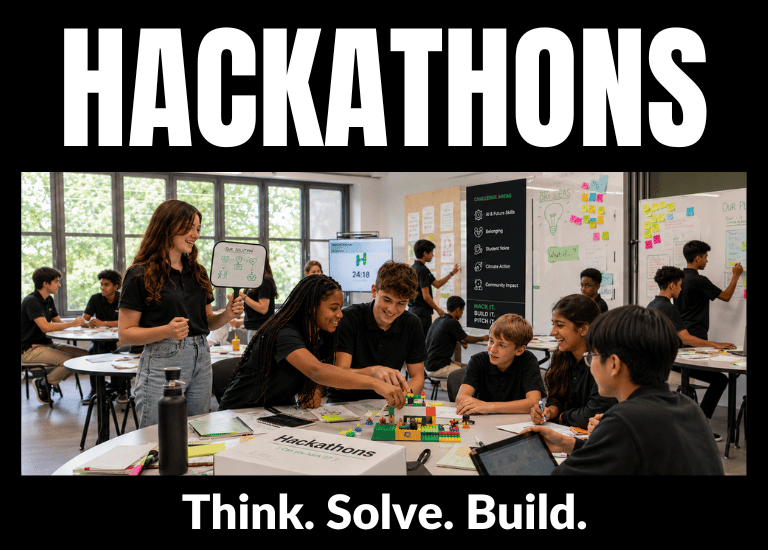
A Hackathon is an industry-style innovation sprint that connects curriculum to real-world problem-solving. Students investigate a meaningful challenge, build a visible response, test it, improve it and pitch what they created.
TRIPOD Hackathons give Years 7 to 12 students the opportunity to explore the big questions shaping their future, build real-world solutions and practise the Ethical and Intercultural Capabilities schools want to see in action.
Perfect for kicking off or wrapping up the year!
What problem will your students solve today?
Students explore issues they are already thinking about: AI, identity, work, housing, climate, community, voice and belonging.
Challenges explore connection, student voice, identity, respectful relationships, future pathways and the kind of school culture where students feel seen, heard and ready for what comes next.
One question. Every year level builds a different answer.
Peer-to-peer learning can be built in, with older students testing, mentoring and showcasing with younger year levels.
Talk to us to design an option that fits your students, your priorities and your budget.
Pricing
Minimum numbers apply.
Flexible formats: 2 hours, half or 3/4 day.
Flexible delivery: One cohort or a whole-school Hack.
Talk to us to design an option that fits your students, your priorities and your budget.
Program Information
- This program is available for students from Years 7 to 12, including VCE and VCE VM where relevant.
- Hackathons can be delivered as a 2-hour sprint, half-day or 3/4-day experience.
- The challenge language, facilitation and final outcomes are tailored for Years 7–8, Years 9–10 and Years 11–12 / VCE VM.
- The program can be delivered to one cohort, multiple year levels or as a whole-school Hack.
- Peer-to-peer learning can be built in, with older students testing, mentoring and showcasing with younger year levels.
- A gymnasium, hall or large open learning space will be required. Classrooms can be used for smaller groups.
- Access to power points is required.
- Access to a projector is required.
- Student supervision by teachers is required throughout the session.
- Expert facilitators lead the experience.
- All materials and student resources are supplied.
- Each team receives a Hack Box to support the challenge.
- Slides, prompts and activity guides are included.
- Pre and post lesson support for teachers and student reflection activities are included.
- Challenges can connect to future-ready capabilities, student voice, real-world problem-solving, Ethical Capability and Intercultural Capability.
Years: 7-12
Curriculum Links
Curriculum links can be made across English, Humanities, Civics and Citizenship, Economics and Business, Health and Wellbeing, Design and Technologies, Digital Technologies and the Critical and Creative Thinking, Personal and Social, Ethical and Intercultural Capabilities.
For Years 11–12 and VCE VM, the sprint supports applied skills including communication, collaboration, problem-solving, planning, initiative, enterprise, resilience and adaptability.
- VCE VM Work Related Skills
- VCE VM Personal Development Skills
- VCE VM Literacy
- VCE VM Numeracy